Australian Open: Sabalenka eyes return to glory, Swiatek chases career Grand Slam
'%20transform='translate(-56%20-679)%20translate(40%20141)%20translate(16%20538)'%3e%3cg%3e%3cpath%20fill='%23000'%20fill-rule='nonzero'%20stroke='%23979797'%20stroke-width='.5'%20d='M6.608%200C2.964%200%200%202.99%200%206.667c0%203.676%202.964%206.666%206.608%206.666%203.644%200%206.608-2.99%206.608-6.666S10.252%200%206.608%200zm0%201.111c3.048%200%205.507%202.48%205.507%205.556%200%203.075-2.459%205.555-5.507%205.555-3.048%200-5.507-2.48-5.507-5.555%200-3.075%202.46-5.556%205.507-5.556zm-.55%201.111v5h3.854v-1.11H7.16v-3.89H6.058z'%20transform='translate(1.322%201.333)'/%3e%3c/g%3e%3c/g%3e%3c/g%3e%3c/g%3e%3c/g%3e%3c/svg%3e)
The first grand slam of 2026 is upon us, with the Australian Open getting going on Sunday.
There was something of a shock result Down Under in 2025 as Madison Keys stunned Aryna Sabalenka 6-3 2-6 7-5 in the final to claim her first grand slam title, having also overcome Iga Swiatek in the last four.
Keys was just the second player since 1990 to defeat the WTA's top two players in the semi-final and final en route to an Australian Open title, after Jennifer Capriati in 2001.
But both Sabalenka and Swiatek will hope to fare better this time around, with the former chasing a third triumph in the last four editions of the tournament and the latter eyeing a career Grand Slam.
Coco Gauff and Amanda Anisimova join Keys in the American contingent, having both made waves at last year's majors, while two-time champion Naomi Osaka, teenagers Victoria Mboko and Mirra Andreeva, plus returning legend Venus Williams, are all names to keep an eye on.
Ahead of the tournament, we use Opta data to pick out all the main contenders and possible outsiders to watch.
Sabalenka chases return to Melbourne dominance
Last year, Sabalenka was within a set of becoming the sixth woman to win three straight editions of the Australian Open.
Margaret Court (1969-1971), Evonne Goolagong (1974-1976), Steffi Graf (1988-1990), Monica Seles (1991-1993) and Martina Hingis (1997-1999) had previously achieved that feat, and when Sabalenka levelled up the showpiece match on Rod Laver Arena, she looked destined to join them.
But Keys found a second wind and Sabalenka crumbled in the deciding set, with errors creeping into the Belarusian's game as she suffered her second defeat in a major final.
Another would follow at the French Open in June, against Gauff, and Sabalenka also fell short at Wimbledon, though her second success at Flushing Meadows prevented a season without grand slam success.
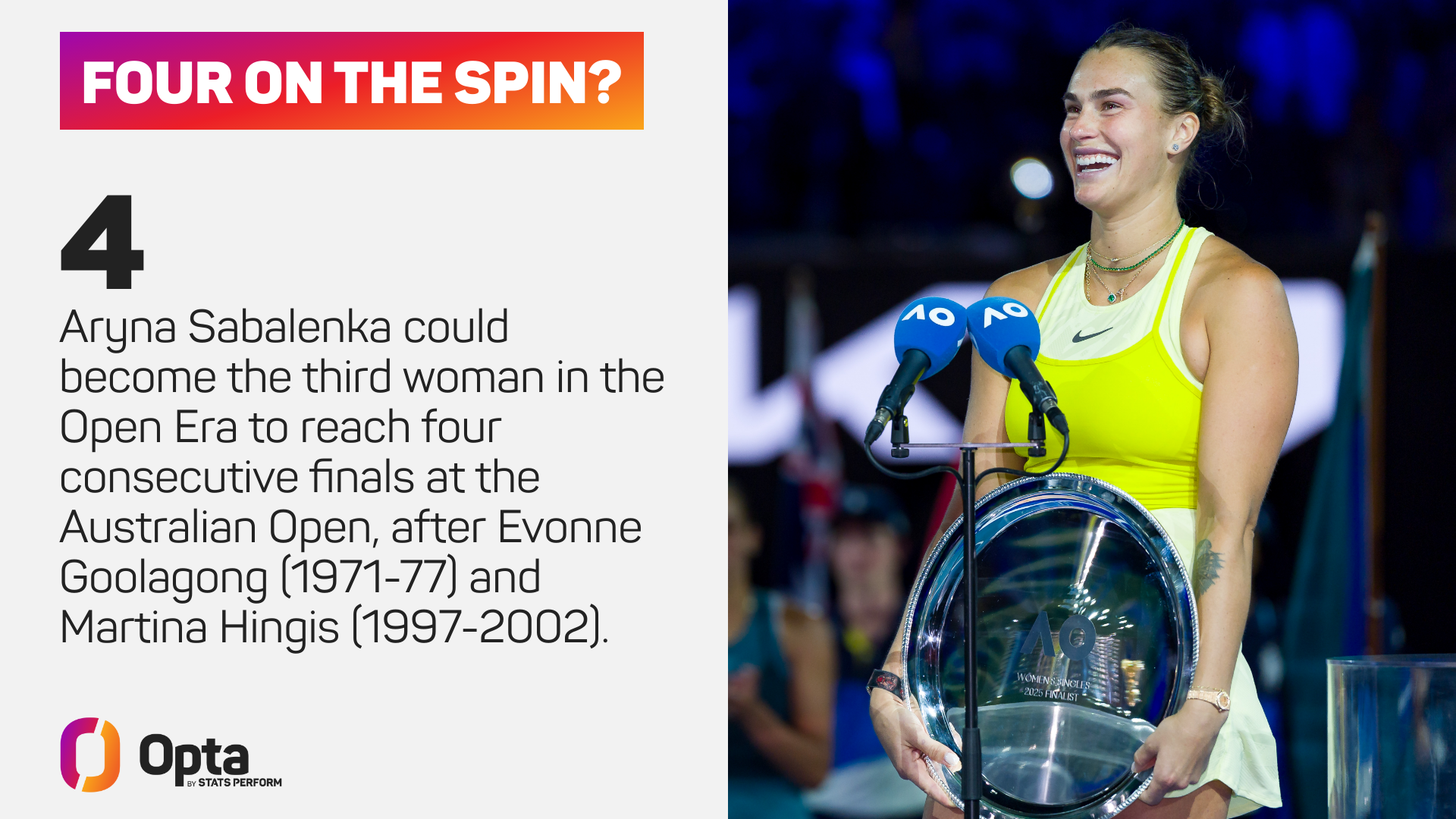
Having spent the entirety of last year as the world number one, Sabalenka will now look to become the third player in the Open Era to reach four consecutive women's singles finals at the Australian Open, after Goolagong (1971-77) and Hingis (1997-2002).
She was just the fifth player to hold the number one ranking for an entire calendar year, after Graf (1990, 1994), Seles (1992), Serena Williams (2014, 2015) and Ashleigh Barty (2020, 2021).
Across the grand slams, only at the US Open (85%, 34-6) does Sabalenka boast a better win percentage than she does at the Australian Open (82%, 28-6), and after going 63-12 at WTA events last year, Sabalenka will be determined to transfer that consistency into more major success in 2026.
It would take a brave person indeed to bet against her.
Swiatek eyes place among the greats
Since the Australian Open switched to hard courts in 1988, only three women have ever achieved a career Slam – they are Graf, Serena Williams and Maria Sharapova.
Swiatek is bidding to join that illustrious group in the coming weeks, having claimed her first Wimbledon crown in 2025, to go with her 2022 US Open success and her four Roland-Garros triumphs.
The 24-year-old has not gone through an entire season without winning at least one grand slam title since 2021, and she could now become the seventh female player in the Open Era to go through five consecutive seasons winning at least one major in each.
Chris Evert (1974-1986), Graf (1987-1996), Navratilova (1981-1987), Serena Williams (2012-17), Billie Jean King (1971-75) and Justine Henin (2003-07) all did so.
4 - Iga Swiatek (now 63 wins in 2025) is the fourth female in the Open Era to lead the Tour in term of wins for 4+ consecutive seasons (2022-2025) after Chris Evert (1974-1977), Martina Navratilova (1977-1986) and Steffi Graf (1987-1990). Legendary.@WTA @BJKCup @iga_swiatek pic.twitter.com/8dkkbeJE7O
— OptaAce (@OptaAce) November 16, 2025
But before she can dream of lifting the Daphne Akhurst Memorial Cup, Swiatek must do something she has never done before at the Australian Open – get past the semi-finals.
The Pole's two best runs at Melbourne Park came in 2022 and 2025, with both seeing her come up short against an American opponent in the last four (Danielle Collins in 2022, Keys in 2025). Her other five appearances all ended in the fourth round or earlier.
Swiatek has a point to prove at this event, but last year was the first time she reached at least the quarter-finals of all four slams within a single year.
Like Sabalenka, she was a picture of consistency and is a player to be feared.
Gauff, Keys and Anisimova aim to keep WTA Tour wide open
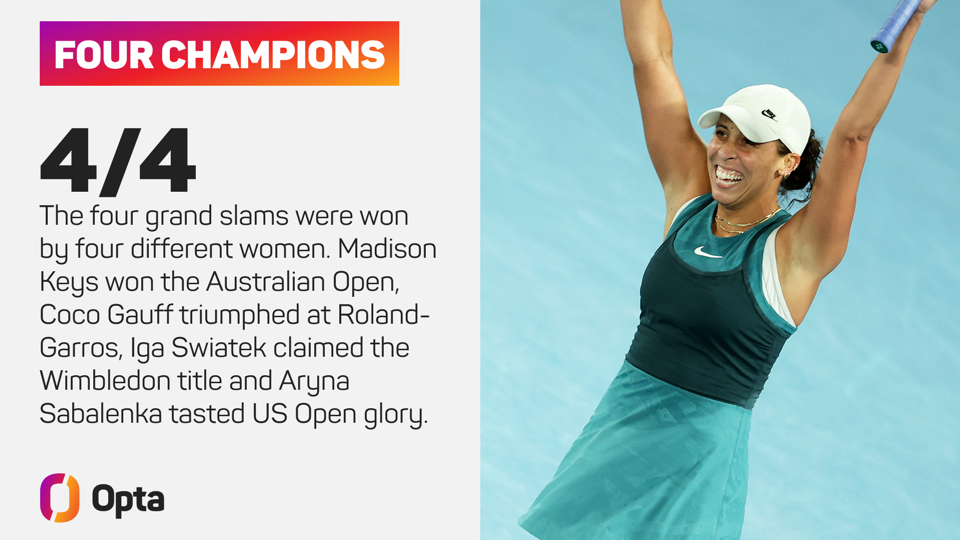
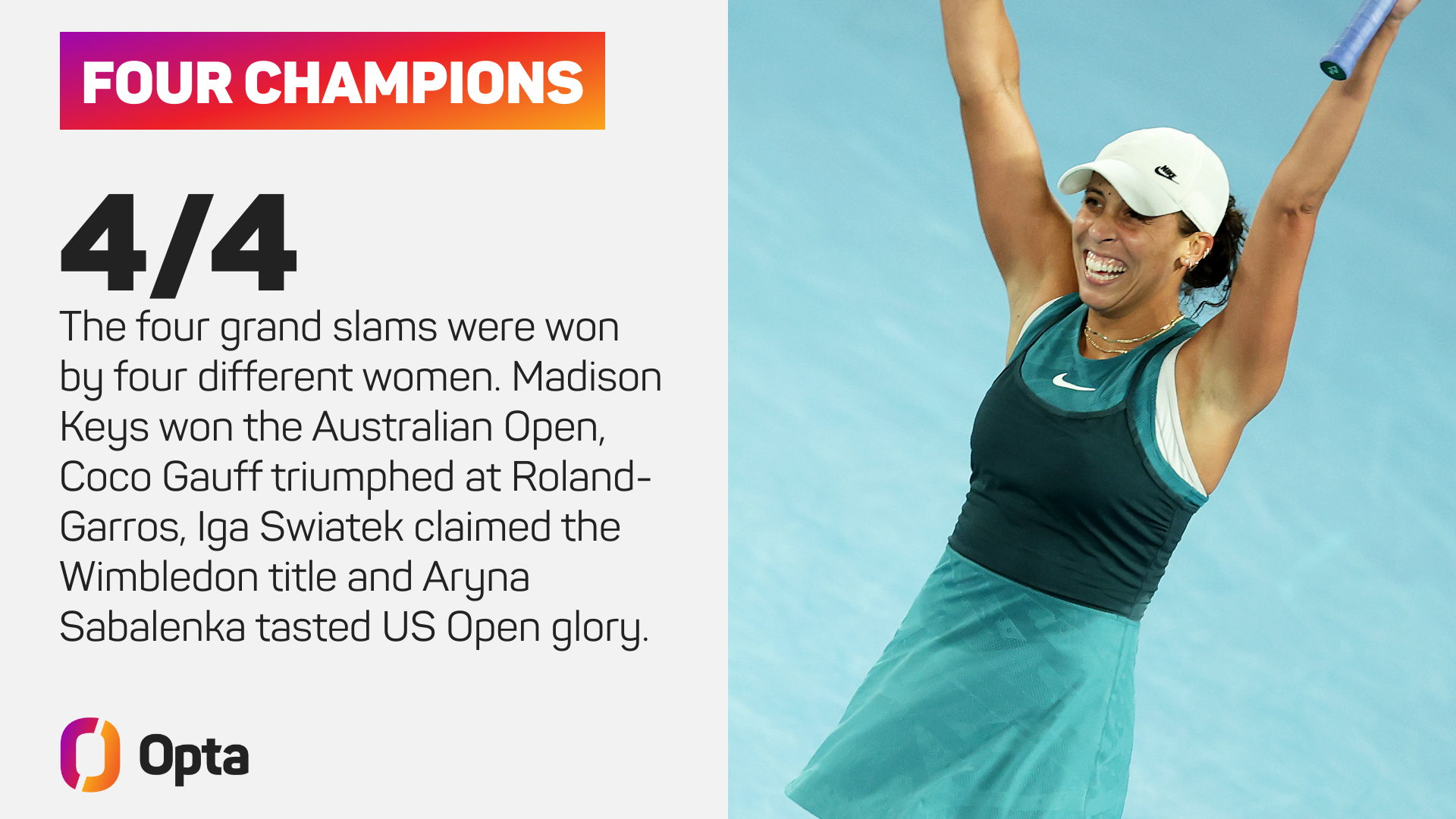
Last year, four different women won the four grand slam titles.
That was a far cry from the ATP Tour, as, for the second successive season, Jannik Sinner and Carlos Alcaraz split the major crowns between them.
There are a trio of American players looking to upset Sabalenka and Swiatek, and that's without touching upon world number five and WTA Finals champion Elena Rybakina.
Four women have successfully defended the Australian Open title in the 21st century – Capriati (2001, 2002), Serena Williams (2009, 2010), Victoria Azarenka (2013, 2014) and Sabalenka (2023, 2024).
Keys is aiming to achieve that feat this time around, but she will hope for a smoother run than her arduous path to the title in 2025.
Keys conceded the most games of any women's singles champion in Australian Open history (87) and had to go through three-setters from the round of 16 onwards, making her the first player to win the title from such a position in the Open Era.
Last year also brought a landmark achievement for Gauff, the golden girl of US tennis.
At the age of just 21, Gauff became the youngest woman to win grand slam titles on multiple surfaces since Sharapova triumphed at Wimbledon in 2004 and the US Open in 2006, having launched a stunning fightback to beat Sabalenka in Paris.
But it was Anisimova who reached the most major finals among the American contingent last year, falling short both at Wimbledon and Flushing Meadows.
Anisimova will be highly motivated to get over the line in 2026, and she showcased her ability with WTA 1000 title wins in Doha and Beijing last season.
4/4 - Amanda Anisimova is the only player able to defeat each of the 2025 Women’s Singles Grand Slam champions this year (Madison Keys, Coco Gauff , Iga Swiatek and Aryna Sabalenka). 2026-Targets.#WTAFinalsRiyadh | @WTA @WTAFinalsRiyadh pic.twitter.com/iqLvwWzmiG
— OptaAce (@OptaAce) November 7, 2025
She became just the fourth player born in the 21st century to win multiple WTA 1000 titles in a season, after Bianca Andreescu (2019), Swiatek (2022, 2024) and Andreeva (2025).
And the 24-year-old was also the only player who defeated each of the top three in the WTA rankings (Sabalenka, Swiatek and Gauff) in 2025, as well as the only player to defeat each of the four grand slam champions.
Her aim for 2026 will be to put herself among that group, and the Australian Open represents her first chance to do so.
Osaka, Mboko and Andreeva on the rise, Venus to make history
There are plenty of other captivating storylines to keep a close eye on, too.
Let's start with Osaka, the only other player in the women's singles draw – alongside Sabalenka – with multiple Australian Open titles on her CV, after Azarenka was snubbed for a wildcard spot.
The 2019 and 2021 victor has steadily climbed back to 16th in the world rankings, having achieved her best grand slam result since early 2021 by reaching the semi-finals of last year's US Open, where she lost to Anisimova in a three-set epic.
One place behind Osaka in the current rankings is Canada's 19-year-old breakout star Mboko, who earned an eye-catching win over second seed Keys at the Adelaide International this week.
Mboko defeated Osaka to win her first WTA 1000 crown at the Canadian Open last year, becoming only the second wildcard in the Open Era to win the tournament, after Seles in 1995.
1 - Victoria Mboko is the second player since the WTA-1000 format introduction in 2009 to claim her maiden WTA title at such level after … Naomi Osaka (Indian Wells 2018). Beginning.#OBN25 | @OBNmontreal @WTA pic.twitter.com/uLe17El4Z5
— OptaAce (@OptaAce) August 8, 2025
She was also just the third woman to win a WTA 1000 event as their first tour-level title (after Osaka and Andreescu at the 2018 and 2019 Indian Wells Opens, respectively).
Mboko reached her third WTA final in Adelaide, only to go down in straight sets to Andreeva.
The 18-year-old Russian is seeded eighth here and will also be confident of a deep run, having never failed to reach at least the fourth round. She also made grand slam quarter-finals on different surfaces last year (at Roland-Garros and Wimbledon) and it appears a matter of when, not if, she captures her first major crown.
And at the other end of the age spectrum, Venus Williams will appear at her 22nd edition of the Australian Open, and her first since 2021.
The 45-year-old will become the oldest woman to ever feature in the main draw of the Australian Open, having made her grand slam return at Flushing Meadows five months ago.
Williams (54) has won the most women's singles matches at the Australian Open among active players, ahead of the absent Azarenka (50).
She has never won the tournament, though, and is one of only four women in the Open Era to have reached multiple finals at Melbourne Park without lifting the trophy.
If she did so here, it would go down as arguably the greatest sporting comeback in history.
Henin is the only wildcard to reach the women's singles final at the Australian Open in the Open Era, losing in the 2010 showpiece to Venus' sister Serena. The only other wildcard to reach a women's singles final at a major was Kim Clijsters, at the 2009 US Open.
It is far more likely Venus bows out early on what will surely be her Australian Open farewell, but neither Osaka nor Mboko should be discounted for a deep run.